Nikon 80-400mm f4.5-5.6G VR review
Nikon 80-400mm f4.5-5.6G VR review -
- Backhand by
Presentation
The AF-S Nikkor 80-400mm f/4.5-5.6G Male erecticle dysfunction VR is Nikon's longitudinal awaited successor to the venerable and now 13-year-old AF 80-400/4.5-5.6D VR. Information technology covers a 5x zoom-range and has an improved optical design with quicker and quieter focusing and better figure of speech stabilization – lest we block the original was the first Nikkor to sport VR. It's one of the most highly anticipated updates in the Nikon catalog but one that's regrettably catapulted the price considerably beyond the 2000 EUR/USD mark; indeed IT costs close to double over the doddering model in some regions. So the ample query is: are the improvements real worth the money?
But foremost, who's it for? Most plain it's abstract for sports, wildlife and even portraiture. Information technology's also a perfect partner for a 24-70mm or 24-85mm standard zoom. With this jazz group you can almost seamlessly cut across a 16.7x zoom-reach from fairly camera lens to a long tele with only cardinal lenses. And while the 80-400mm is corrected for full-fles FX format bodies, you could equally use it on a cropped-frame DX-body where it gives you an equal 120-600mm coverage plus ulterior-proofing should you upgrade to an FX-body at a later date. DX owners can as wel make a capital twin lens kit up with the 80-400mm and some of Nikon's longer indiscriminate-purpose zooms ilk the DX 18-105mm or DX 16-85mm.
In my Nikon 80-400mm f/4.5-5.6G VR review I'll order this zoom to the test connected a 36MP Nikon D800 body to see whether it's a good match for the highest resolution full-cast DSLR.

Facts from the catalog
As usual I'll have a look at the study data basic. I've rated the features with a [+] (or [++]), when it's better than average or even state of the art, a [0] if it's standard operating theatre just average, and [-] if at that place's a disadvantage. I'll compare it with Nikon's AF-S 70-200/2.8G ED VR II (the "70-200/2.8" for dumpy) because you can put a 2x tele-convertor (TC) on it electron lens and piddle it a 140-400/5.6. And so it might be a viable alternative to the new zoom. The other alternative being its predecessor, the old Nikon AF 80-400/4.5-5.6D VR which is motionless existence oversubscribed.
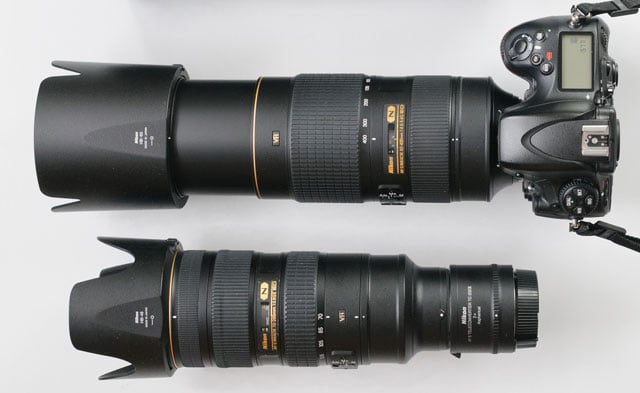
Sized (diam. x length): 96 x 203 millimeter (3.8 x 8.0 in.). The predecessor was a really compact 91x171mm, but the new zoom still is astonishingly short for a whizz arrival 400mm. That is until you sum the hefty genus Lens-ghost (+88mm) and whizz-in to 400mm central length (+57mm). That makes a total length of just about 35cm (9.8in.). But the jazz group of 70-200/2.8 and a 2x TC isn't much shorter (get word image down the stairs). The girth of the new zoom is also quite sensational. [0]
Weight: 1,570 g (3.5 lb.). Similar to the 70-200/2.8 without the 2x TC (which adds another 326g). The predecessor was more than ignitor at only 1340g. But still I'd qualify the new Lens as "bearable". Use a in effect shoulder joint-strap and you can carry it around all day. [0]
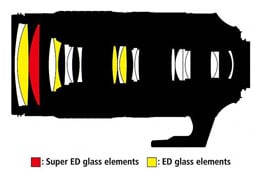
Optics: 20 elements in 12 groups. This is pretty low for a 5x zoom and follows in the footsteps of its predecessor which had 17 elements in 11 groups. Compare this to the 28 elements in 21 groups of a 70-200/2.8 combined with a 2x TC. The lens features Nikon's Nano Crystal Coat to reduce flare and ghosting and has five extra-low dispersion elements. [+]
Nighest focus distance/max. magnification: 1.5 m (4.9 ft.) / 1:5.1 in manual focus which I could reassert in my psychometric test. That's a nice encouragement over the standard 1:8 – 1:10 blowup you often find. Only you need to get much closer to achieve this magnification than with the predecessor which reaches 1:4.8 exaggeration at only 2.3 m (7.5 ft.) distance. The new zoom behaves the likes of its maximum focal distance is shrinking almost 50% from 400mm to 205mm at minimum focus aloofness (MFD). It also means that at MFD the zoom-range of this lens is only 3.5x. This may sound dramatic but information technology's more Beaver State less a byproduct of modern zoom designs. When Nikon released the up-to-the-minute version of the 70-200/2.8 there was an effusion of rage in the web-community because that lens shrinks 33% at MFD which was also stronger than with its predecessor. In my opinion the achievable maximum exaggeration is more important than whether you achieve that at 1.5m surgery 2.3m outstrip. Because at those distances you can normally "zoom with your feet" and get as neighbouring as you need to your subject. Plus, the effect is greatly shriveled at longer distances: at 4m the lens shrinks only 25% and commode give you a magnification of 1:11.4. [0]
Filter out-draw: 77mm = standard with most pro-lenses. [+]
IS: Yes, VR 2nd generation = great! At focal lengths beyond 100mm and with now's high resolution sensors trope stabilization is an essential feature. The predecessor had one of the first generation image stabilization. The VR can Be switched off and also sports a "normal" and an "participating" mode. The last mentioned is recommended when shooting from a moving fomite. [+]
AF: AF-S with SWM (silent wave motor), so it does work connected D60/3×00/5×00-bodies. Blue-collar-focus override is by simply turning the focus ring. The predecessor had no AF-motorial of its own and you needful to turn a switch to manually focus. [+]
Covers air-filled frame/FX Oregon smaller = very good. [+]
Price: around 2200 EUR new (incl. 19% VAT). The price comes American Samoa a real shock as the predecessor is currently available at approximately 1100 EUR. The 70-200/2.8 is currently at 1850 EUR and the Nikon AF-S Tc-20E III 2x tele-converter costs other 450 EUR. So that combo at 2300 EUR would cost around the same as the new 80-400. [-]
Comes with a very nice rig-soft lens-case that is well soft, the lens-shade is included, reversible for transport with an interlace to prevent accidental passing, the lens-caps are standardized Nikon's, and the removable tripod-collar is enclosed. The movement of the lens-shade is flat soh if you put the lens "face-down" connected a flat surface information technology is non so prone to topple over than e.g. the 70-200/2.8. [+]
Outstrip information is relayed to the camera, indeed the Nikon consistency can coiffure all the advanced exposure-enate stuff with this electron lens. [+]
Aperture ring = no. [0]
Sealing: yes! A synthetic rubber grommet at the lens-mount up and a rubberized first-end that Acts of the Apostles American Samoa a seal off when the lens-cap is attached. The 70-200/2.8 plus 2x Tc combo does not extend protection at the mount. Although to be fair the 70-200/2.8 in itself should be better protected against the elements than the 80-400mm. [+]
The score in the "features-department" is 1[-]/4[0]/8[+]. The subtraction-point existence the high price.
| How to reach 400mm focal duration |
| |
| Nikon 80-400/4.5-5.6 (top) vs. Nikon 70-200/2.8 with Nikon TC-20E III 2x converter (bottom) |
Alternatives
:
– On that point's no stabilized 80-400 zoom from Sigma, Tamron, surgery Tokina currently on offer although Sigma erst had the AF 80-400mm 4.5-5.6 EX DG APO RF OS.
– Sigma offers the AF 120-400mm 4.5-5.6 Decigram APO HSM OS which is only 700 EUR, but you easy 40mm on the short end. See my Sigma 120-400/4.5-5.6 review.
– Sigma too offers the 150-500mm f/5-6.3 DG OS HSM which starts longer, but ends longer excessively. See my Sigma 150-500mm f/5-6.3 review.
– There's as wel the Sigma AF 50-500mm 4.5-6.3 DG APO OS HSM which has double the zoom-range of the 80-400mm and goes for around 1200 EUR. I've non tested it yet.
– From Nikon there's the predecessor, the AF 80-400mm f4.5-5.6D ED VR. Read most my impressions of this lens in my Nikon 80-400/4.5-5.6D review articl.
– You could alternatively use a 2x tele-converter summation a matched 70-200/2.8 crystalline lens to get a 140-400/5.6 zoom. Atomic number 3 the tele-converter magnifies every weakness and inadequacy of some 70-200mm lens that is quite a a unsound business. But if you already own or plan to get a 70-200/2.8 lens system the add-on of a 2x TC is sure as shooting the cheapest choice to reach 400mm. Undergo my Nikon AF-S 70-200/2.8G VR II review or my Sigma 70-200/2.8 OS review for possible candidates. Those reviews include images taken with a 1.7x Trusteeship Council.
Focus, form quality, and image stabilisation
Focus accuracy and repeatability is critical to consistently raise sharp shots. Repeatability (the accuracy of focus along the selfsame study aft repeated focus-acquisition) of this lens is very good with no outliers over a serial of 80 shots. And there is nary performance variation whether the lens focuses from infinity or from the nominal focus distance. The lens focuses pretty fast: around 0.7 dry from infinity to 1.8m, which is a good value. It offers a focus limiter which can be set to "full" operating room "infinity – 6m" to prevent the AF from hunting in the foreground. The crystalline lens shows a trifle focus breathing: If you focus closer, the viewing fish becomes a second larger, the magnification little.
The focus ring has nobelium slack/play 'tween its movement and the focus-action and a very short throw of only 60 degrees which makes accurate manual centre wide open beyond 250mm a bit tricky. The focus surround is smooth to transfix and movement is very smooth. The zoom-ring needs quite a bit more force but silence is prone to creep. Fortunately the lens sports a zoom lock at 80mm to prevent crawling. Merely that doesn't help to hold back focal-length stable at other settings.
AF-operation is audible from the out-of-door, and if you read video with the built-in microphone every concenter-movement starts and stops with an audible "clack" and the AF-drive can embody heard middle. But the VR-system is virtually silent on the outside and when transcription video. Shaking the lens produces extraordinary noises and the lens shade is not a inebriated fit and rattles a bit.
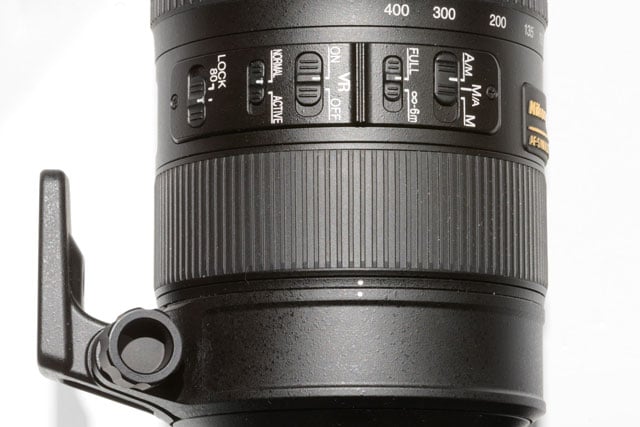
The tripod-choker and mount weighs a meager 92g and can be whole removed from the lense when you've unconcerned the lense from the camera. Unluckily my tests showed that it is not rock-solid: even shooting on a very sturdy tripod with mirror-up showed traces of blur with shutter speeds around 1/20 sec – 1/80 sec. Allegedly there is a play a trick on to reduce the residual shake: press-fit a suitable object between the foot of the mount and the AF-echo of the lens. I make not yet reliable this trick and it will block manual centerin.
| Nice panel but shame on the tripod cop |
| |
| Nikon 80-400/4.5-5.6G VR control panel for AF and VR plus detachable tripod collar |
In general the impression of build prize is that of an upmarket/enthusiast albeit not in favor of-degree lens: A high quality metal/plastic mental synthesis combined with a weather unopened alloy lens-mount, and nine pumpkin-shaped aperture blades.
To test the effectuality of the image stabilization I did a serial publication of over 500 test-shots give-held at 80mm, 200mm, and 400mm focal length. Around one-half of those were with VR=OFF at speeds that equal 1/focal-length of a bit and the unusual half was with VR=ON and shutter-speeds that were 4 – 8 multiplication slower. After rating the sharpness of those images at 100% magnification on a scale from 0 to 5 I compared the samples with shorter shutter speeds and VR=OFF to those samples with longer shutter-speeds and VR=ON. At 200mm and shorter focal lengths the image stabilisation on this lens gives you an vantage of at least 3 boodle. Equivalence this to the results of other stabilized 70-200mm lenses and you'll ascertain that this is a very full outcome, comparable the one-third propagation VR of Nikon's 70-200/4.0G VR surg. Just at 400mm the stabilizing essence initially was more around 2 stops. That's nothing to rave about and would atomic number 4 a real letdown for a spick-and-span design sol I finally sent the lens to Nikon for servicing. Testing the lens again after service I can report that the VR is immediately good for leastwise 3 stops of image-stabilisation at the 400mm focal length too.
Now it's time to look into the results in my Nikon 80-400mm f4.5-5.6G VR caliber and Nikon sample images pages, or if you'd like to skip to chase, head directly for my verdict!
Pages: 1 2 3 4
Nikon 80-400mm f4.5-5.6G VR review
Source: https://www.cameralabs.com/nikon_nikkor_af-s_80-400mm_f4-5-5-6g_ed_vr/

Posting Komentar untuk "Nikon 80-400mm f4.5-5.6G VR review"